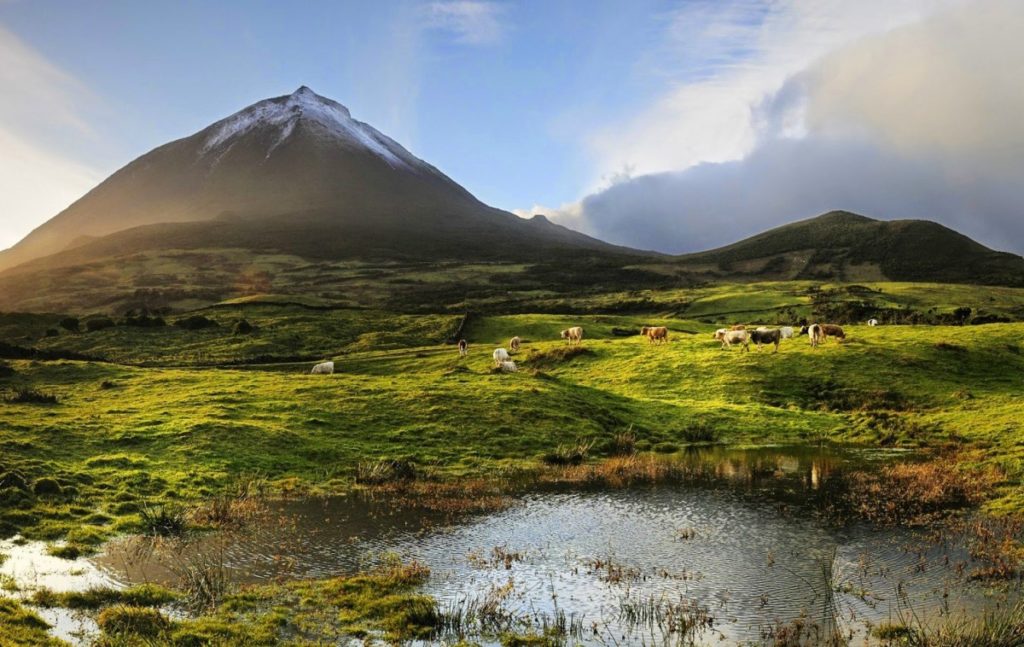
Climbing Pico Mountain is one of the most memorable experiences in the Azores. At 2,351 meters, it is the highest point in Portugal and a demanding volcanic hike where preparation, weather, timing, and safety matter as much as the view from the top.
This is not a hike to improvise. The trail starts at the Mountain’s House; registration is required, visitor capacity is controlled, and the weather can change quickly. In this guide, you will find the practical information you need to plan the climb: official booking, prices, opening hours, equipment, guided options, transport, weather, and local partner offers.
Pico Mountain in 30 seconds
Table of Contents
| Altitude | 2,351 metres, the highest point in Portugal. |
|---|---|
| Trail start | Mountain’s House, Caminho Florestal n.º 9, Candelária, Madalena. |
| Distance | About 3.8 km to Piquinho; roughly 7.6 km return. |
| Elevation gain | About 1,150 metres. |
| Average duration | 3 to 4 hours up + 3 to 4 hours down. |
| Difficulty | Not technical, but physically demanding and on irregular volcanic terrain. |
| Booking | Required for independent climbs, overnight stays and capacity control. |
| Guide | Not always mandatory, but highly recommended for safety and overall experience. |
Where does the Pico Mountain climb start?
The climb starts and ends at the Mountain’s House, located at about 1,200 meters of altitude, in the Candelária area of Madalena municipality. This is where visitors register, receive safety information, and where entries and exits from the Pico Mountain Nature Reserve are controlled.
The Mountain’s House also serves as an interpretation and support center, providing information on the geology, biology, history, climate, and legal framework of the Nature Reserve. After descending, visitors must return to the Mountain’s House to confirm that they have completed the trail.
What is the Pico Mountain climb like?
The Pico Mountain trail follows volcanic terrain, with sections of earth, rock, gravel, and mud. Vegetation is low and usually grows outside the route. If you are stepping on vegetation, you may already be off the official trail.
There are 47 wooden trail markers along the route. The last marker is located inside the crater and indicates the route to Piquinho, the mountain’s highest point. In foggy conditions, visibility can drop quickly. If you cannot see the next marker within about 30 minutes, the safest approach is to return to the previous marker and regain the trail.

Climbing Pico Mountain.
The ascent usually takes between 3 and 4 hours, depending on fitness level, pace, weather, and breaks. The descent also normally takes between 3 and 4 hours, and, for many visitors, it is the hardest part because of the impact on the knees and the unstable volcanic ground.
If you are climbing and descending during the day, plan your descent with a margin. The official recommendation is to always start descending at least 4 hours before sunset, because descending after dark significantly increases risk.
Recent content to keep planning better
What can you see from the top of Pico Mountain?
Near the top, you reach the volcanic crater, often referred to as Pico Grande. From there, the final section leads to Piquinho, the highest point, where fumaroles can be seen and where visitor time is limited due to capacity restrictions.
On clear days, the reward can be extraordinary: Pico Island below you, the Pico-Faial channel, São Jorge, and sometimes other islands of the central group. But it is important to be realistic: the view is not guaranteed. Clouds, fog, and wind can cover the mountain even when the general forecast looks acceptable.

View from the top of Pico Mountain on a clear day.
Do you need a guide to climb Pico Mountain?
A guide is not always mandatory. It is possible to make an independent climb, provided the official reservation and registration are completed, and the Pico Mountain Nature Reserve rules are followed.
However, for most travelers, climbing with a guide is the safer and more comfortable option. Pico Mountain is not technically difficult, but it is physically demanding and can become risky in fog, rain, wind, or ice, or when fatigue or limited mountain experience are factors.
| Option | When it makes sense | What to consider |
|---|---|---|
| Independent climb | For people with good fitness, hiking or mountain experience, and solid orientation skills. | Requires official booking, proper equipment, and more responsibility for risk management. |
| Guided climb | For first-time climbers, limited experience, night climbs, sunrise, sunset or overnight experiences. | Costs more, but improves safety, pacing, interpretation, and group management. |
Local partners for climbing Pico Mountain
If you prefer to climb with someone who knows the mountain well, start by checking the local partners available through MyAzoresHome. Besides improving safety and pacing, a certified guide can add context about the geology, climate, history, and landscape of Pico Island.
Some MyAzoresHome partners offer discounts, special conditions or direct booking advantages. Open each card and check how to redeem the benefit: by code, link, direct contact or availability request.

TRIPIX
- Day and night climbs on Mount Pico
- Sunrise, sunset and crater options
- Certified guides and local experience
A strong option for experiencing Mount Pico with professional guidance and an exclusive MyAzoresHome discount.

GO CLIMB
- Mount Pico climb in small groups
- Flexible pace and private option
- Certified guide with safety focus
A good option for climbing Mount Pico with more support, better pacing and a more personalized experience.

GO CLIMB
- Mount Pico climb with overnight stay
- Sunset, night on the mountain and sunrise
- Certified guide and small group format
A more special and memorable way to experience Mount Pico, with more time, a different rhythm and a unique mountain setting.
Important: first choose an activity above and click “Request availability”. The form will be prepared automatically with the correct partner.
Official prices to climb at Pico Mountain
Independent climbs are subject to an official fee. These are the prices indicated for the Mountain’s House:
| Type of independent climb | Official fee |
|---|---|
| Climb to Furna Abrigo | €5 |
| Climb to the Crater | €15 |
| Climb to Pico Pequeno / Piquinho | €25 |
| Overnight stay at the Crater | €10 |
| Azores residents | Free, upon presentation of the Citizen Card. |
These prices refer to independent climbs and do not include guide services. If you book with a company, the final price depends on the type of experience, number of people, schedule, transport, overnight stay and included services.
Mountain’s House opening hours
Opening hours vary throughout the year and may change depending on weather conditions. Always confirm official information before your climb.
| Period | Official opening hours |
|---|---|
| May 1 to September 30 | Open 24 hours. |
| April 1 to April 30 | Monday to Thursday: 8:00 a.m.–8:00 p.m. Friday: 8:00 a.m.–11:59 p.m. Saturday: midnight–11:59 p.m. Sunday: midnight–8:00 p.m. |
| October 1 to October 31 | Monday to Thursday: 8:00 a.m.–8:00 p.m. Friday: 8:00 a.m.–11:59 p.m. Saturday: midnight–11:59 p.m. Sunday: midnight–8:00 p.m. |
| November 1 to March 31 | Every day: 8:00 a.m.–6:00 p.m. |
| Closed | January 1 and December 25. |
Daily capacity and booking
Pico Mountain has visitor limits to protect the Nature Reserve and improve safety. The trail capacity is 160 visitors at a time, with a maximum of 320 per day. Piquinho has a stricter simultaneous capacity and each visitor’s stay there is limited.
In high season, especially from June to September, booking in advance is strongly recommended. Even with a booking, weather conditions may affect the operation, so it is wise to leave some flexibility in your itinerary.
Mandatory and recommended equipment
Equipment is not a minor detail. The Mountain’s House may prevent a climb if visitors do not meet the minimum safety requirements.
| Mandatory / essential | Recommended |
|---|---|
| Closed hiking shoes or mountain boots with good grip. | Walking poles, especially for the descent. |
| Clothing suitable for mountaineering. | Raincoat / windbreaker. |
| Water: at least 1.5 L per person. | Hat, sunglasses and sunscreen. |
| Food / energy snacks. | Extra warm layer, even in summer. |
| Flashlight if climbing or descending at night. | Gloves and beanie, especially outside summer. |
| Tent, sleeping bag, flashlight and extra warm clothing for overnight stays. | Power bank and fully charged phone. |
| Crampons if there is snow or ice. | A small bag to bring all rubbish back down. |
Each visitor receives a GPS tracking device, which must be returned at the end of the activity. Failure to return it or damaging it may result in extra costs. The GPS improves safety, but it does not replace good judgment, proper equipment, orientation, and respect for official instructions.

The descent from Pico Mountain is often the most demanding part.
Overnight stay in the Pico Mountain crater
Sleeping in the crater is a special experience, but it has specific rules. Overnight stays are subject to reservation and a maximum number of visitors per day. To stay overnight, you must bring suitable equipment, including a tent, sleeping bag, flashlight, and extra warm clothing.
This option is not recommended for people without experience, without tolerance for cold and wind, or simply looking for a “different” activity without preparation. A night on the mountain can be tough, and sunrise is only worth it if the conditions are reasonably favorable.
Can children and minors climb Pico Mountain?
Children up to 12 years of age must be accompanied by an adult during the visit. Minors under 16 must be accompanied by a person with parental authority or by an adult duly authorized through a written statement.
Even when allowed, the climb should be assessed carefully. The distance, elevation gain, terrain and descent may be too demanding for some children or teenagers without hiking experience.
Weather on Pico Mountain: the main risk factor
The weather on Pico Mountain can change quickly. The temperature at the top is usually around 10 ºC lower than at sea level. You may start in sunshine and face wind, cold, fog or rain higher up.
Fog is especially dangerous because it reduces visibility and can make the trail markers hard to see. Wind can also make the climb more difficult, especially near the top and in exposed areas.
How to get to the Mountain’s House
The easiest way to reach the Mountain’s House is by car. The road climbs to a higher-altitude area and, depending on where you are staying, you should allow enough time to arrive, park, register and prepare your equipment.
If you do not have a car, confirm taxi, transfer or transport options in advance. Do not rely on last-minute solutions, especially for early morning climbs, sunrise, late afternoon, sunset or high season.
Useful contacts
| Mountain’s House | Caminho Florestal n.º 9, Candelária, 9950 Madalena |
|---|---|
| Phone | +351 967 303 519 |
| [email protected] | |
| Official booking | montanhapico.azores.gov.pt |
| Madalena Fire Department | +351 292 628 300 |
What if you do not want to climb?
You do not need to climb Pico Mountain to feel its presence. The mountain dominates the island’s landscape and can be seen from many places, especially on clear days.
If you do not have the fitness, time, equipment or interest to do the climb, you can still build an excellent Pico itinerary around the mountain: viewpoints, the vineyard landscape, Lagoa do Capitão, Madalena’s coastline, Lajes, São Roque and several places where the mountain becomes the natural backdrop.
Conclusion: is Pico Mountain worth climbing?
Yes, absolutely — as long as you are properly prepared. Climbing Pico Mountain is one of the great experiences in the Azores, but it requires respect for the mountain, the weather and your own physical limits.
If you have experience, good equipment and favourable conditions, an independent climb can make sense. If it is your first time, if you want to climb at night, see the sunrise, sleep in the crater or simply reduce risk, choose a certified guide. In any case, check the weather, book in advance and leave enough flexibility in your itinerary to change the day if the mountain is not safe.
Do you need a guide to climb Pico Mountain?
No. It is possible to make an independent climb through the official booking system. However, if you have limited mountain experience, plan to climb at night, want to see the sunrise or intend to stay overnight, a certified guide is recommended.
How long does it take to climb Pico Mountain?
The ascent usually takes 3 to 4 hours. The descent also usually takes 3 to 4 hours. Total time depends on fitness level, pace, breaks and weather conditions.
Where does the Pico Mountain climb start?
The climb starts at the Mountain’s House, on Caminho Florestal n.º 9, Candelária, in Madalena municipality, Pico Island.
How much does it cost to climb Pico Mountain?
For independent climbs, official fees are €5 to Furna Abrigo, €15 to the Crater, €25 to Pico Pequeno / Piquinho and €10 for an overnight stay in the Crater. Azores residents are exempt upon presentation of the Citizen Card.
What is the best time to climb Pico Mountain?
The most popular period is between May and September, when there are more daylight hours and generally better chances of favourable conditions. Even so, mountain weather can change quickly, so always check the forecast and official conditions before climbing.
Can children climb Pico Mountain?
Children up to 12 years old must be accompanied by an adult. Minors under 16 must be accompanied by a person with parental authority or by an adult duly authorized through a written statement. The decision should consider fitness, experience and safety.
Can you sleep in the Pico Mountain crater?
Yes, but overnight stays are subject to booking, visitor limits and mandatory equipment, including tent, sleeping bag, flashlight and extra warm clothing.
What equipment is mandatory to climb Pico Mountain?
You must bring clothing and footwear suitable for mountaineering, water, food and, for night climbs, a flashlight. For overnight stays, tent, sleeping bag, flashlight and extra warm clothing are mandatory. Crampons may be required in snow or ice conditions.