If you are planning a trip to the Azores, chances are you have already checked the weather app on your phone, seen a rain forecast for several days in a row, and thought your holiday might end up being spent under grey skies. That is one of the most common worries for first-time visitors to the islands.
The truth is that, in the Azores, a general forecast is not always the best tool to decide your day. What really matters is not just knowing whether “it will rain”, but understanding where the weather is better at that moment, because that can change a lot within the same island.
Unlike many mainland destinations, the Azorean climate is strongly shaped by relief, the ocean, wind, and altitude. In practice, that means you can have fog in a high area, overcast skies on one coast, and good, clear spells in another part of the island just a few kilometers away.
That is exactly why locals in the Azores do not rely solely on a generic forecast. The most useful approach is usually to combine the official forecast with a more practical reading of the island and adapt the day to what is actually happening in each area.
That is also the logic behind our Live Weather in the Azores page, created to help travelers understand the day better and make more useful decisions than simply accepting a rain icon on a phone screen.
In this article, I explain the logic behind microclimates in the Azores, why a general forecast can be misleading, and how our tool — supported by sources such as IPMA and webcams — helps you interpret the day more effectively. I also explain why, in many situations, having a car makes all the difference if you want to “follow the better weather”.
- Why a general forecast can be misleading: in the Azores, relief and wind exposure create important local differences.
- What our weather tool does: it helps you read the day more practically, by area, with a best bet and an alternative.
- Where IPMA and webcams fit in: they remain useful support tools for confirming trends, issuing warnings, and reflecting real conditions.
- Why a car changes everything: knowing where the better weather is matters much more if you are free to get there.

How it works (in 1 minute)
Table of Contents
- 1) In the Azores, do not assume that a general forecast applies equally to the whole island.
- 2) Check our Live Weather in the Azores tool to better understand which areas may have the best conditions and what the most sensible alternatives are.
- 3) Use IPMA to check the general trend and warnings, and webcams as visual support whenever you want to confirm what the terrain looks like in real time.
- 4) If you have a car, adapt the day and head to the area where the weather is more open.
Why the weather in the Azores works differently
In the Azores, the climate is strongly shaped by volcanic geography and the constant proximity of the ocean. The islands have mountains, craters, wind-exposed slopes, high areas, and more sheltered valleys. All of this affects how clouds form, gather, and release moisture.
In practice, this creates what many people call microclimates: weather differences that can be significant within the same island, especially between the coast, inland areas, and higher elevations. On some days, this becomes very obvious.
Recent content to keep planning better


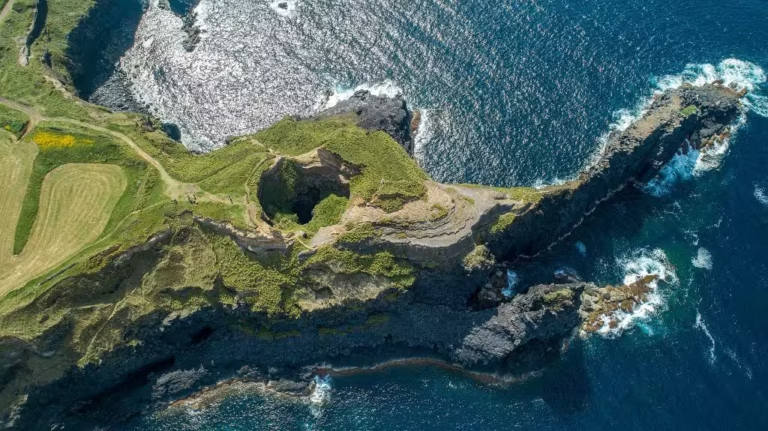

That is why a simple forecast showing “rain” or “cloudy” can be too generic to plan your day properly. One area may have rain or fog while another still has good, clear spells, especially when altitude, wind, and coastal exposure come into play.
The MyAzoresHome tool: a more practical way to read the day
That is exactly why we created the Live Weather in the Azores page. Instead of simply repeating a general forecast, the tool was designed to help travelers interpret the day more practically.
In practice, the tool helps you understand which parts of the island may have better conditions at that moment, suggests a best bet and an alternative, tells you what to bring, and highlights useful points in the area. In other words, it turns scattered weather information into something more practical when deciding what to do.
This does not mean ignoring official sources or real-time observation. It means adding a more useful layer of interpretation for people who are actually on the islands and want to decide between a viewpoint, a lagoon, a coastline, a swimming area, or a more sheltered activity.
Where IPMA and webcams come in
IPMA remains important to understand the forecast, warnings, and the general trend. Real-time webcams remain very useful when you want to confirm what the sky actually looks like at specific points on an island.
But for someone trying to plan the day in a practical way, the most useful approach is to treat these sources as support rather than the only basis for a decision. That is where the MyAzoresHome tool helps bridge the gap between the forecast and the real on-the-ground choice.
Local tip: in the Azores, what matters most is not only knowing whether rain is in the forecast, but understanding where the weather is better and what still makes sense to do that day.
SpotAzores: useful support on the ground
One of the most useful external tools to complement this reading is SpotAzores, which brings together real-time webcams across the 9 islands of the archipelago. It is especially helpful when deciding whether to head to a lagoon, a specific coastline, a swimming area, or a more exposed trail.
Instead of relying only on a general forecast, you can use webcams to validate the real conditions of a specific point. Even so, for a quicker and more travel-oriented interpretation of the day, it makes sense to start with our Live Weather in the Azores page and then, if needed, go deeper with webcams and the official forecast.
You can download the official SpotAzores app for free and access webcams across the islands.


How this logic plays out on the main islands
São Miguel
São Miguel is probably the island where most people notice this difference. Sete Cidades, Lagoa do Fogo, and other higher areas can be closed in, while the south coast, Caloura, and parts of the Nordeste may have much better conditions. The common mistake is to assume that the weather at one single point represents the entire island.
Pico
On Pico, the mountain has a huge influence on how the day feels. Clouds may get trapped at altitude while, at the same time, conditions are much better near the coast or in another part of the island. Before making decisions about climbing or more exposed areas, it is worth checking the actual conditions.
Terceira
On Terceira, conditions can vary considerably between different parts of the island. If the weather looks more closed along one coastline, it may still be worth checking another area before giving up on your plan.
Flores
On Flores, the weather can change quickly throughout the day, and the relief creates strong contrasts between areas. Here, a practical reading of the terrain is especially useful before setting off toward viewpoints or waterfalls.
Why does having a car make such a difference when the weather matters
Knowing where the better weather is only becomes truly useful if you have the freedom to change areas without losing hours. That is where having a car makes all the difference in the Azores.
With a car, you can adapt the day to the reality of the island: swap one closed viewpoint for another, move from the mountains to the coast, leave a lagoon for later, and make the most of a swimming area or a restaurant with a view where the sky is more open.
Without that flexibility, you are much more dependent on schedules, fixed tours, or pure luck in being exactly where the weather happens to be better at that moment.
If you want to apply this logic in practice, it is worth checking our guide “Renting a Car in the Azores”. You can also visit the Partners & Promotions page, where we bring together useful rent-a-car options, services, and travel advantages.
So… should you trust the weather app less?
This is not about ignoring the forecast. The best approach in the Azores is to use it more intelligently. The forecast helps you understand the day’s general trend, but it should not be seen as an exact picture of the whole island.
In practice, the most sensible approach is usually to:
- use a tool designed to interpret the day in a more practical way;
- check the official forecast and warnings.
- confirm real-time webcams when it makes sense;
- and only then decide which part of the island makes the most sense for your plan.
That combination usually removes a lot of stress from the trip and helps you understand that “rain in the Azores” does not always mean “the day is lost”.
Frequently asked questions
Is the weather forecast in the Azores always wrong?
No. The forecast is still useful, especially for understanding the day’s general trend and any warnings. The point is that, in the Azores, a generic forecast may not accurately reflect the whole island because of local differences in relief, altitude, and exposure.
What are microclimates in the Azores?
There are weather differences that can happen within the same island, often between the coast, inland areas, and higher elevations. This is caused by the combined influence of the ocean, wind, altitude, and volcanic relief.
Are webcams worth checking before deciding the day?
Yes. In the Azores, real-time webcams can be a very practical way to confirm which parts of an island have better conditions at that moment, especially when used as a complement to a more practical reading of the day.
Does having a car help deal with the weather in the Azores?
Yes, because it allows you to adapt the day to the island’s reality and quickly move to another area if the weather is more closed than where you originally planned to go.
Does the MyAzoresHome live weather tool replace the official forecast?
No. The idea is not to replace the official forecast, but to help interpret it more practically by combining the logic of the day with areas, alternatives, and real travel context.
Conclusion
In the Azores, understanding the weather is not just about asking whether it will rain. What matters most is understanding where the better conditions are and how to adapt the day to the island’s reality.
That is exactly why the official forecast and webcams are still useful, but they become much more valuable when placed inside a practical decision-making logic. And that is the role of our Live Weather in the Azores tool: to help turn scattered information into a simpler, quicker, and more useful choice for travelers.
And to put that logic into practice, having a car remains one of the most effective ways to make the most of the best weather available each day.